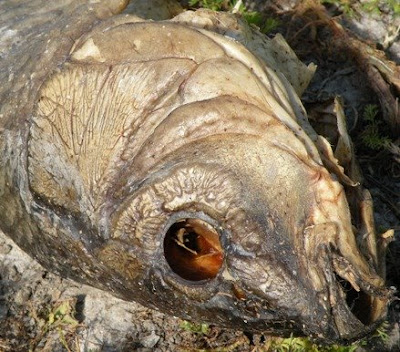
I realize when most people think of minnows, they typically picture a small, silvery fish ranging in size from pizza topping to bait. Minnows in California, however, tend to be especially large, with many species greater than two feet in length. This dead fish, a common carp (not native to California), was a tad over 24 inches. It is in the minnow family.
As one of the most successful fish families in California, minnows here have evolved to fill all sorts of niches that we don't ordinarily expect them to occupy. For example, the Sacramento pikeminnow is a large, predatory species that feeds almost exclusively on fish and grows to three feet in length. The Sacramento blackfish, which can be found at Kokopelli Wildlife Area, is like the whale shark of California's fresh water, cruising through still backwaters and filtering tiny particles of food from the water.
One interesting thing about minnows is that they don't have any teeth in their jaws. So all you swimmers who got out of the water when I wrote about the pikeminnow can get back in. They do have teeth, but they are located back in their throat and they are called pharyngeal teeth. And, like other animals, you can usually get a pretty good idea of what they eat by looking at their teeth. The pikeminnow has sharp, knifelike teeth for gripping and shredding live fish. This is what the teeth of the dead carp looked like (this picture is taken from the bottom side of the fish looking just behind the gills):
I'll post some pictures of the grinding surfaces of these teeth another time, but you can see they look sort of like molars. Carp use these to grind plant materials against the bony plate above. I hope to clean this specimen up and create a clean skeleton from lips to the back of the throat to show kids how minnows eat.
For more information about California fish, I highly recommend Peter Moyle's landmark text: Inland Fishes of California. It's really, really, really, really........great.


 I was able to follow this beaver around for several minutes before he got too busy for me. I snapped a few crummy photos as well as captured a little video.

 You'll also notice that not only was it not good enough to merely number each pole, but also to name them "PL" which, to my knowledge, stands for pole, or maybe powerline. Brilliant. These letters are probably about 8" tall and they are possibly smelted from 98% pure sterling silver to avoid corrosion. I know what you're thinking: four symbols times fifty poles equals 200 characters. Wow. Especially at what, $7 or $8 bucks a pop? But is that really good enough? What if you're standing somewhere that you can't see the labeling? What do you do then? Circle the pole while hopelessly lost, looking for some kind of sign to tell you where you are? Which direction do you go? Clockwise? Counter?


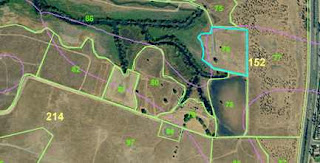 The different labels and lines and colors all mean different things. In this example, the large yellow numbers correspond to soil types and the small, green numbers are the numbers of the parcels that I carved out of Kokopelli WA. When a parcel is clicked, a magical spreadsheet opens up that tells you everything you need to know about that specific piece of ground. I know this all sounds really cool, but just imagine how much more fun it is to actually do it. But before you get to do all this fun stuff, some poor stooge has to actually enter in the data and draw the boundaries, and all that other exciting stuff. Enter Pikeminnow, the wildlife biologist.
 killdeer