01 May 2009

Learning from Dead Stuff--1 May 2009

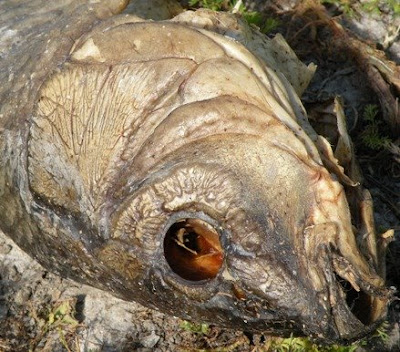
One thing that most wildlife biologists really like to do is find dead stuff. Dead stuff falls into many categories including fresh, too old to stink, and "Holy cow, what is that burning in my nose?". Not that there are only three categories--it's more of a continuum. This piece of carrion fell somewhere closer to "too old to stink" than "Holy cow!" so I decided to examine it a little more closely.


I realize when most people think of minnows, they typically picture a small, silvery fish ranging in size from pizza topping to bait. Minnows in California, however, tend to be especially large, with many species greater than two feet in length. This dead fish, a common carp (not native to California), was a tad over 24 inches. It is in the minnow family.


As one of the most successful fish families in California, minnows here have evolved to fill all sorts of niches that we don't ordinarily expect them to occupy. For example, the Sacramento pikeminnow is a large, predatory species that feeds almost exclusively on fish and grows to three feet in length. The Sacramento blackfish, which can be found at Kokopelli Wildlife Area, is like the whale shark of California's fresh water, cruising through still backwaters and filtering tiny particles of food from the water.


One interesting thing about minnows is that they don't have any teeth in their jaws. So all you swimmers who got out of the water when I wrote about the pikeminnow can get back in. They do have teeth, but they are located back in their throat and they are called pharyngeal teeth. And, like other animals, you can usually get a pretty good idea of what they eat by looking at their teeth. The pikeminnow has sharp, knifelike teeth for gripping and shredding live fish. This is what the teeth of the dead carp looked like (this picture is taken from the bottom side of the fish looking just behind the gills):


I'll post some pictures of the grinding surfaces of these teeth another time, but you can see they look sort of like molars. Carp use these to grind plant materials against the bony plate above. I hope to clean this specimen up and create a clean skeleton from lips to the back of the throat to show kids how minnows eat.


For more information about California fish, I highly recommend Peter Moyle's landmark text: Inland Fishes of California. It's really, really, really, really........great.


30 April 2009

Drawdown-- 30 April 2009


It's that time of year at Kokopelli Wildlife Area. The time when we drawdown our seasonal wetland cells to grow the moist soil plants to feed next year's migratory waterfowl. By drawing down during this time of year, we tend to germinate our most desired waterfowl food plants-- primarily smartweeds and watergrass. You can see extensive mudflats in these photos. The mudflats are areas that we disked last summer in order to keep the vegetative communities at an early successional stage.
By drawing the water down gradually, we concentrate the invertebrates that have been multiplying all year long, creating ideal feeding conditions breeding waterfowl and for migrating shorebirds like these:

long billed dowitcher

western sandpiper

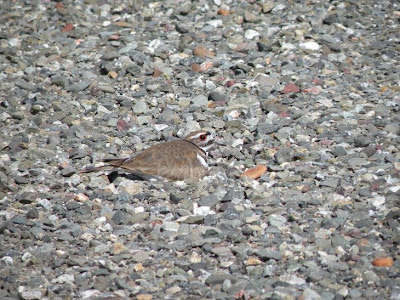
killde--wait! that's not a killdeer
semi-palmated plover
(notice only a single breastband and a white forehead--also much smaller)

blacknecked stilt
We also concentrate larger prey items such as fish and crayfish to help feed other species like these:
American white pelican
notice the plate on the bill which only grows during breeding season
This next bird is a fairly uncommon visitor to Kokopelli WA and it reminds me of fishing from a boat on Lake Sabrina with my father and brother. I used to have a lot of fun watching them dive and then trying to predict where they would pop back up.

western grebe
We also have a large heron, egret and cormorant rookery. Right now they are trying to feed their young and the steady supply of easy pickings during drawdown helps them out quite a bit.
I only was out of the truck for about an hour, but when I got back, I felt one of these near my boots. I found another one later in my office and I still feel about a hundred phantom(?) ticks crawling all over me.

24 April 2009

Species Spotlight, Vol. 2, Killdeer, 24 April 2009

Sorry...It's been a month to the day. Here you go, Gramps--a reprieve from the French Fry Sparrows.

Species Spotlight, Vol. 2, Killdeer


Order: Charadriiformes


Family: Charadriidae


Species: Charadrius vociferus

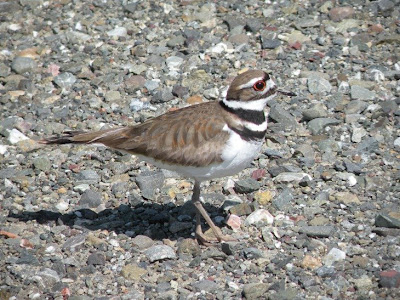
Anyone who has been around Killdeer (especially during the nesting season) can probably guess how they got their specific name. Can you say noisy? The killdeer is one of several species of birds that are very adaptable to human activity. They often nest on gravel roads (such as the bird featured here today). Ordinarily I wouldn't recommend placing a nest of eggs on a roadway, but they seem to know how to pick out the edges where they won't meet rubber doom. Another location where killdeer are often successful nesters is on rooftops and they have been observed keeping their eggs cool in temperatures up to 138 degrees by soaking their belly feathers in water. The young reared on rooftops have been observed surviving falls of up to 50 feet. One thing they haven't adapted to, however, are raingutters, with the young sometimes becoming stranded as they cannot fly.


The killdeer is a type of shorebird known as a plover, which as a group are often identified by their short bill, round head, and plump body. A lot like Grandpa, except his bill is probably longer. A common bird here at Kokopelli WA, the killdeer is very striking with its red eye, orange rump and smooth lines.


The killdeer has several adaptations for nesting on the ground. It exhibits a plumage pattern called disruptive coloration, allowing it to blend in extremely well with gravel roads and other nesting substrates. The double breast band and the lines on its face are two examples of this.


Additionally, their eggs are spotted and streaked in order to blend in with the surrounding rocks. The killdeer places these eggs in a carefully scraped out nest. On gravel roads, they are often lined with small, white pieces of quartz.
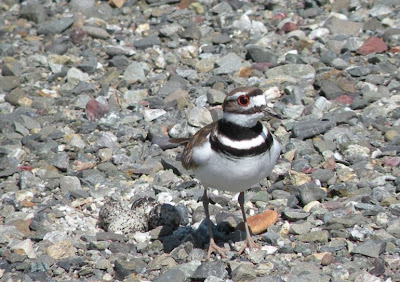
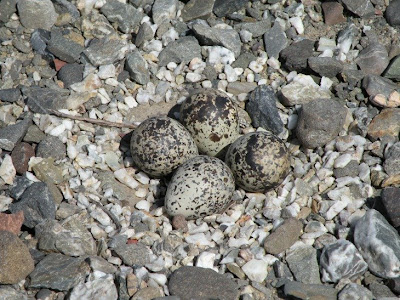
While sitting at the nest, or when protecting young, the parent exhibits a distraction technique to lure predators away from the nest when disturbed. They put on a very believable (and noisy) broken wing distraction dispaly worthy of an award from the Academy.
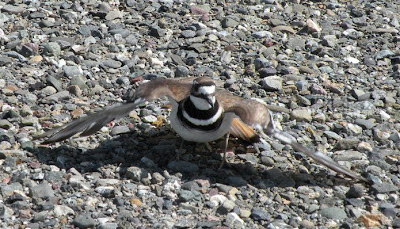


After the young hatch, they are on their feet immediately, running around almost as well as their parents, although the do trip and fall from time to time--something which causes my children to giggle hysterically whenever they see it. They can't fly until they get older and their downy feathers are replaced with genuine flight feathers.


References:

Patuxent Bird Identification InfoCenter

Birders Handbook: A Field Guide to the Natural History of North American Birds

The Sibley Guide to Birds


24 March 2009

FOS Kingbird and an Odd Couple -- 24 March 2009

One of my favorite things about spring is the anticipation of new bird arrivals from their wintering grounds. Swainson’s hawks, orioles, and others are cool, but for me, the bird that means spring at Kokopelli WA is the western kingbird. Unfortunately, I was not at work on the day (Friday the 20th) the first kingbird was spotted here, but I saw one on Monday the 23rd that I was able to snap a few crummy pics of. Since nobody told me that there had been any seen here yet, I still had the excitement of thinking this was the first. You can imagine my disappointment to find out I was only second. Crushing. That same day I saw two more.

They are a really beautiful bird with their gray uppers and lemon yellow underneath. Also distinctive is their black tail with fine white edging on the outer tail feathers. They are in the same family as the Say’s phoebe that I profiled here, and as I mentioned, they are rarely seen at Kokopelli on the same day. I believe our last phoebe sighting was on March 19th, so we only missed by one day this year!

I also liked this photo of a double crested cormorant and friend (red-eared slider). Usually you don’t see the crests on these birds, but in the breeding season you can spot them. This day was particularly windy, so the tufts were blowing around like a balding guy with a bad comb-over. I kept waiting for him to slick them back.

17 March 2009

St. Patty's Photo Dump-- 17 March 2009

Since I got my new camera, I'm trying to be committed to organizing my photos every couple of months. So here are a few shots from the first couple of months of 2009 that didn't make the front page.

savannah sparrow

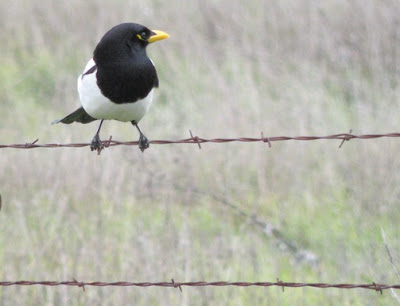
yellow-billed magpie--only in California

mourning dove


jackrabbit attacking disc


cottontail


California quail


box elder bugs


Anna's hummingbird in the middle of morning stretching


American pipit

06 March 2009

Receding Floodwaters-- 6 March 2009


Now that a couple of weeks worth of rain have passed through, the floodwaters at Kokopelli WA are beginning to recede. Typically, the summer water levels at KWA are about two feet below sea level, held at bay by a dike with a top elevation of about 3.5 feet above sea level downstream of our property. This dike was constructed in the 50’s in order to make farming in the area a little bit easier. Our refuge is located at the bottom of a 50 square mile watershed. The watershed is all below 300 feet in elevation, so the only water receive is rainfall. But, 50 square miles of even moderate rainfall can add up in a hurry. Yesterday, our water elevation peaked at almost exactly 5 feet above sea level—quite a swing, but nowhere near our record level of just over 14 feet. As you can probably imagine, 16 foot swings in surface water elevation can create maintenance issues. We try to storm proof everything we can, but we always have some kind of spring clean-up to do ranging from repairing irrigation systems to removing trash and debris from water control structures to repairing blowouts on our dikes and roadways. The high water levels do make certain tasks easier though, such as trimming trees or repairing wood duck boxes from the comfort of a boat rather than a ladder.

staff gauge showing water at 5'--note how deep 14' would be!

The green behind the staff gauge is a summer road, the trees mark the summer creek bank, and behind that is another road!

this non-native red-eared slider didn't seem to mind the water. Catching a little sun.


Sometimes at this time of year, it’s hard for me to discern between winter and spring. One aspect about Kokopelli WA that differs greatly from the area I was raised is the concept of winter annuals. These are plants that germinate with the first rains and end up completing their cycle before spring really even gets started.

spring? or winter?

closer on the wild mustard

this groundsel is already done for the year

wild radish

I showed some photos of tree swallows utilizing our artificial nest boxes a while back, but these birds are also fond of natural tree cavities. In fact, when a tree dies or begins dying, it enters the period of its existence when it provides the most habitat value for other creatures. Insects begin infestations, providing food for others higher on the food chain, branches snap off leaving rotten cavities for nesting animals and dead snags provide high visibility perches for hunting raptors.

this dying cottonwood provides many cavities for the iridescent tree swallow

Wildlife Notes: Say’s Phoebes are still here—I saw one today. Also, the first Swainson’s Hawks of the spring showed up overhead. Yesterday, I saw two common ravens, which is a fairly rare bird for Kokopelli—this is probably the fifth record.

04 March 2009

Species Spotlight, Vol. 1, Say's Phoebe, 4 March 2009

Today I am introducing a new feature of Field Notes… a column that I hope becomes a regular here called Species Spotlight. In each installment I will pick one species of a plant or animal and fill my entry with useless facts.

Species Spotlight, Vol. 1, Say’s Phoebe

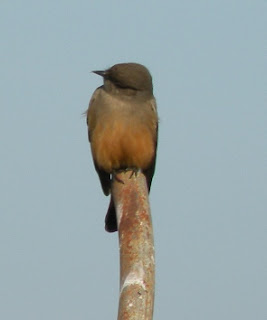
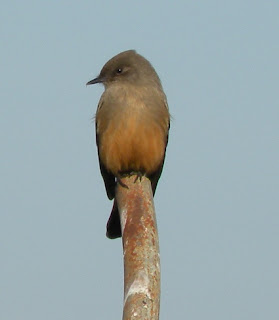
you looking at me?


Order: Passeriformes

Family: Tyrannidae

Species:
Sayornis saya

The Say’s phoebe inhabits Kokopelli WA only during the non-breeding season, although they do breed elsewhere in California. In fact, they will be leaving for the summer any day now. (They may already be gone as I haven't seen one this week.) A slim flycatcher barely over seven inches long, this bird fills roughly the same niche at Kokopelli during the winter as the Western Kingbird does during the breeding season. The Say’s phoebe is a slim, streamlined bird about 7.5 inches long. They are gray with a cinnamon belly and a black tail.

keeping a close eye on a swooping kestrel...

It feeds almost entirely on insects and regurgitates pellets containing the exoskeletons of its unfortunate victims. (Sort of like I do when I forget to take the toothpick out of the club sandwich at Bert’s Diner.) Like other tyrant flycatchers, the Say’s phoebe catches insects on the wing, aided by a powerful ligament connecting the upper and lower jaw which lets them snap their bill shut on flying prey. They also have well-developed rictal bristles, or hair-like feathers protruding from the base of their bill. There are many theories as to the purpose of these bristles, but apparently assisting in prey capture is not one of them. Several studies have been done by biologists who, jealous that they can’t grow any facial hair of their own, clip the bristles off of these poor birds and are able to observe them feeding with no trouble.

In this photo you can see the (unclipped) rictal bristles


References:

Patuxent Bird Identification InfoCenter

Birders Handbook: A Field Guide to the Natural History of North American Birds

The Sibley Guide to Birds