It just so happens that a couple of days before capturing the images for this post, I had attended the
Hedgerow Farms open house and listened to a talk from a representative of the
Xerces Society--a group that advocates for invertebrate conservation. Who knew???
Also, the day before I took these, Gramps had told me he saw a
tarantula hawk and we had a brief exchange about the
Schmidt Sting Pain Index and
velvet ants. Yes, I have strange conversations often.
Anyway, I was visiting a project site that I'm responsible for off-Kokopelli Wildlife Area and noticed a strange, perfectly round hole in the bare ground:

Something retreated inside and I decided to hang around and see if it came back out. Well....

it did. I'm not much of an authority on native bees, but I believe this is a species of solitary bee. As the Xerces Society speaker had informed us, these native bees require bare ground areas to dig their holes in. There is a lot more information about them
here. Although honey bees provide a very valuable service to plants in the USA--they are not native. Even with honey bees performing the bulk of pollination now, there is evidence that the native bees increase their effectiveness. Research has shown that when native bees are present, honey bees tend to switch plants more frequently, leading to increased fertilization of other flowers.
When Gramps told me about the tarantula hawk, I told him that their sting rated a 4.0 on the Schmidt Sting Pain Index, which doesn't sound all that impressive until you realize that the scale only goes up to 4. They use this sting to paralyze tarantulas prior to laying an egg in the still living body of the spider. Then the larvae eats the tarantula (saving the vital organs for last to keep the spider alive) before pupating into a new tarantula hawk. I have heard that the sting from a tarantula hawk will send a person to their knees in pain.
I also told Gramps about the time when I was 7 or 8 and caught a velvet ant (a white one, not like the one pictured below) and it promptly stung me. It was, and still is, the most painful sting I've ever been on the receiving end of. For awhile after that, I had a "kill-on-sight" policy for these creatures. Don't judge me, I was young!
Velvet ants are actually wasps and they are also sometimes referred to as cow-killer wasps because their sting is so painful. It rates as a 3 on the SSPI. The females are wingless and have a stinger, while the males are winged and do not. Usually the two look so different that they would not be recognized as the same species. Shortly after I snapped the pics of the solitary bee, I saw this beautiful velvet ant scurrying about. They are FAST! I was able to capture several crummy photos, however. You can see why they are called "ants".

 sycamore flower
 raccoon tracks
 western pond turtle
 red-eared slider
 henbit, close and...
 closer
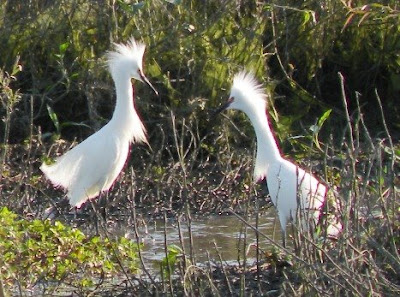
 great egret in full breeding plumage
 Bonaparte's gull

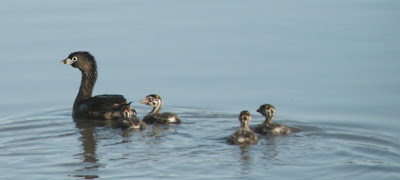
 Pied-billed grebes are excellent swimmers and divers. They often swim around with just their head and neck above the water and look like a snake or small

 Our drawdown was slowed down quite a bit by some late spring rains, but here is the same area of the upper cell as it looked today (the small patch of tules in the center is the same in each photo):
 You can see we're getting some nice growth of our seasonal wetland foodplants. In this unit, we primarily try to grow watergrass and annual smartweed, which are both excellent waterfowl feed. Even as the upper cell is greening up, the lower wetland cell is still completing drawdown. Normally I like to have the water off by now, but an extra week won't hurt anything too much. These birds seemed to like it.




 We also concentrate larger prey items such as fish and crayfish to help feed other species like these:

 We also have a large heron, egret and cormorant rookery. Right now they are trying to feed their young and the steady supply of easy pickings during drawdown helps them out quite a bit.

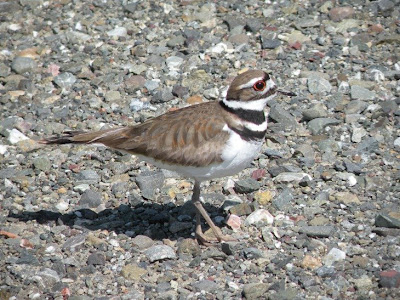 Order: Charadriiformes
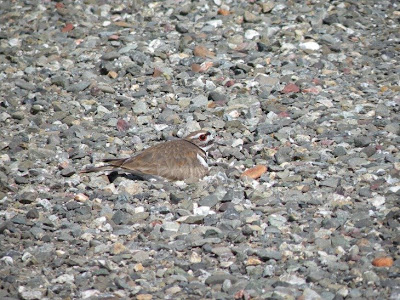 Additionally, their eggs are spotted and streaked in order to blend in with the surrounding rocks. The killdeer places these eggs in a carefully scraped out nest. On gravel roads, they are often lined with small, white pieces of quartz.
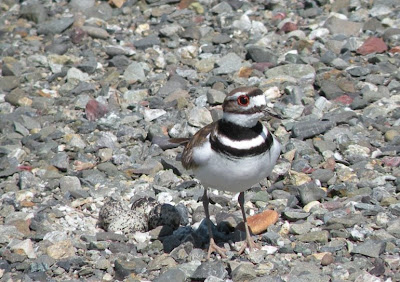
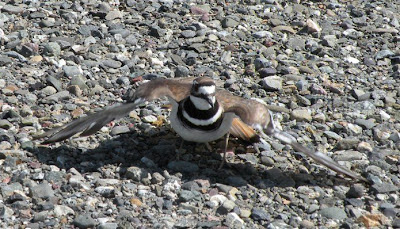
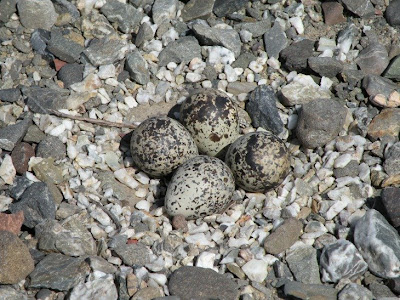 While sitting at the nest, or when protecting young, the parent exhibits a distraction technique to lure predators away from the nest when disturbed. They put on a very believable (and noisy) broken wing distraction dispaly worthy of an award from the Academy.